Cryptographic Protocols and Their Role in Verifying Outcomes Within Distributed Bingo Networks
Erik Lehmann · Jul 12, 2026

Cryptographic Protocols and Their Role in Verifying Outcomes Within Distributed Bingo Networks
Distributed bingo networks operate across multiple independent nodes where each participant maintains a copy of the game state, and cryptographic protocols provide the mechanisms that allow every node to confirm draw results match the agreed rules without exposing private inputs or relying on a single point of control. These systems combine verifiable random functions, commitment schemes, and zero-knowledge proofs so that outcomes generated in one part of the network can be checked by any other participant at any later time.
Core Components of Verification in Distributed Systems
Verifiable random functions generate the numbers that determine bingo draws while producing a proof that anyone can check against a public key, and this approach prevents any single node from predicting or altering the sequence in advance. Commitment schemes require each participant to lock in their contributions to the random seed before the draw occurs, after which the commitments open and combine through a deterministic function that all nodes can recompute identically. Observers note that when these two primitives work together the final bingo number becomes both unpredictable beforehand and publicly auditable afterward.
Zero-knowledge proofs add another layer by allowing a node to demonstrate that it followed the protocol correctly without revealing the underlying random values or participant data. Researchers at institutions across North America and Europe have documented how succinct non-interactive arguments of knowledge reduce the size of these proofs so that verification remains efficient even as the number of network participants grows into the thousands.
Implementation Patterns Observed in 2026
By July 2026 several distributed bingo platforms had integrated hybrid architectures that combine on-chain commitments stored on permissioned ledgers with off-chain computation performed by designated verifier nodes. Data from regulatory filings in Canada and Australia indicate that operators adopted these models to satisfy requirements for outcome transparency while keeping latency low enough for real-time play. The National Institute of Standards and Technology has published guidelines on entropy sources that many of these platforms reference when selecting verifiable random function parameters.
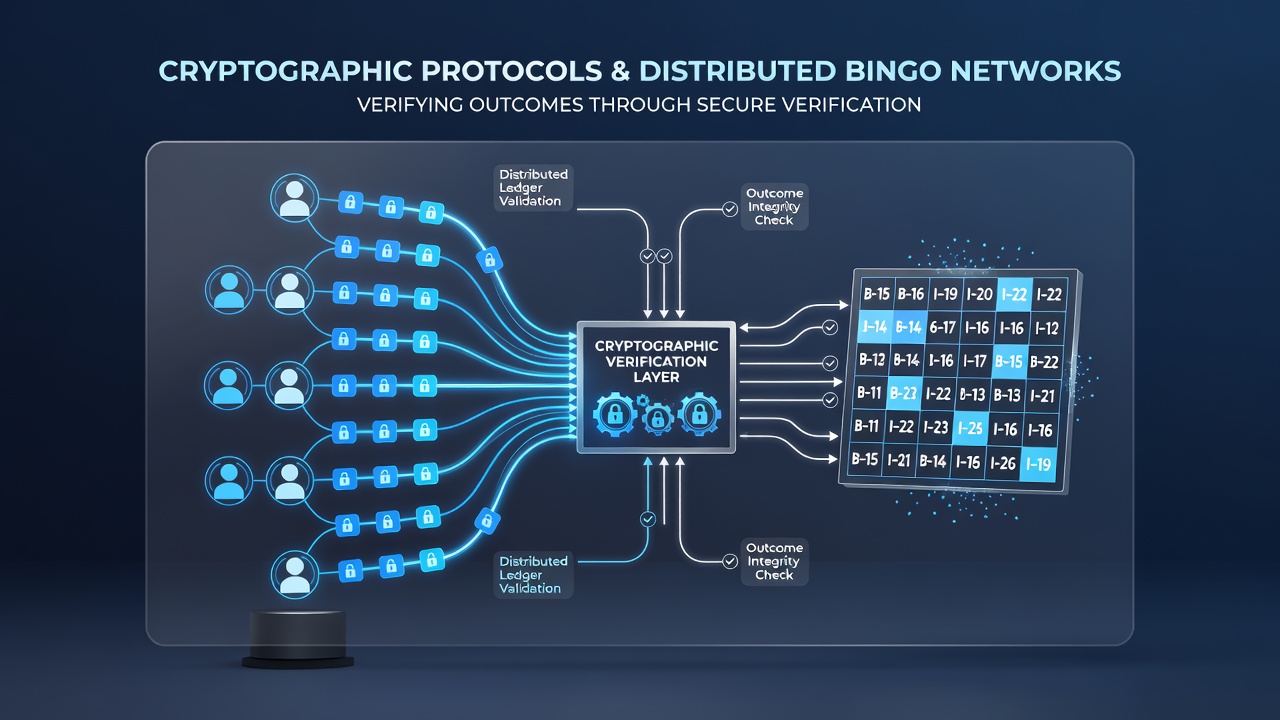
Secure multi-party computation protocols further allow the random seed to be assembled from contributions of multiple nodes so that no single party knows the complete input until the draw completes. This pattern appears in networks where operators must demonstrate compliance to gaming authorities in different jurisdictions, each of which may require distinct audit trails. Figures released by the Australian Communications and Media Authority show a measurable increase in the number of licensed operators submitting cryptographic audit logs during the first half of 2026.
Verification Workflow and Audit Processes
When a draw occurs the generating node publishes both the verifiable random function output and its accompanying proof along with the opened commitments from all participants. Every other node then performs three independent checks: it confirms the proof validates against the public key, it recomputes the combined seed from the opened commitments, and it verifies that the published bingo number matches the deterministic mapping from that seed. Any mismatch triggers an automatic rejection of the draw by the consensus rules encoded in the network software.
Independent auditors receive access to the same public data and can replay the verification steps at any future date, which creates a permanent record that regulators and players alike can examine. Studies published by academic groups in the European Union have measured the computational overhead of these checks and found that modern hardware completes full verification of a single draw in under 50 milliseconds even when the participant set exceeds 500 nodes.
Challenges Addressed by Protocol Design
Network partitions and delayed messages create situations where some nodes may temporarily hold different views of the draw history, yet the use of cryptographic timestamps and proof chaining ensures that once a draw is accepted by the majority it cannot be rewritten without detection. Protocol designers therefore incorporate Byzantine fault tolerance thresholds so that verification remains sound as long as fewer than one-third of nodes behave maliciously. Industry reports compiled by research organizations in Asia and South America document how these thresholds have been tested in simulated failure scenarios that mirror real-world connectivity disruptions.
Key rotation and forward secrecy mechanisms protect long-term participant keys even if an individual node suffers compromise after a draw has already been verified. These features allow networks to maintain continuity while still satisfying the evidentiary standards required by multiple licensing bodies operating under different legal frameworks.
Conclusion
Cryptographic protocols supply the technical foundation that lets distributed bingo networks produce outcomes every participant can independently confirm. Through the coordinated use of verifiable random functions, commitment schemes, zero-knowledge proofs, and secure multi-party computation, these systems deliver both unpredictability before each draw and transparency afterward. Continued refinement of proof efficiency and cross-jurisdictional audit standards will shape how such networks scale while meeting regulatory expectations in the years ahead.